What determines who pays for a balcony repair
The starting point is the plan of subdivision for your building. That plan draws a line around every lot and labels everything outside those lines as common property. A balcony is either inside your lot boundary, outside it, or partly both. The answer to who pays follows directly from where the repair sits relative to that line.
The Owners Corporations Act 2006 then layers obligations on top. The owners corporation must repair and maintain common property. A lot owner must repair and maintain their own lot. If a balcony is common property, the owners corporation pays. If it is part of the lot, the lot owner pays. If the damage crosses the boundary, the cost is split according to who is responsible for which part.
In practice, most balcony repairs in Melbourne apartment buildings involve common property because the structural slab, waterproofing membrane and balcony railings usually sit outside the lot. But the plan of subdivision is the only document that settles it for your building. It overrides any assumption, any verbal advice and any arrangement that worked for a different building down the street.
How to read your plan of subdivision for balcony boundaries
The plan of subdivision is the document that settles the argument. It is registered with Land Use Victoria, and you can order a copy online for a small fee or ask the strata manager for the one on file. Find the plan number on your rates notice or title search first, so you order the right document.
On the plan, each lot is drawn with thick boundary lines. A line on the face of a wall or on the outer edge of a slab means everything to the outside belongs to the lot. A line through the middle of the slab or balustrade means the structure itself is common property and the owners corporation maintains it.
- Check whether the balcony slab sits inside or outside the lot boundary line.
- Check the balustrade the same way, because it can differ from the slab.
- Look for a note on the plan that designates balconies as common property.
- Compare the plan with the building, since as-built details sometimes differ.
- Note whether the balcony is cantilevered off the slab or built on posts or columns.
Most Melbourne apartments built after the 1990s have cantilevered concrete balconies, where the slab and its waterproofing are usually common property. Older walk-up blocks often have timber or steel-framed balconies supported on their own posts, and those supports are more often part of the lot. The plan decides, not the era, so check it before anyone quotes for the work.
When the owners corporation pays for the whole repair
The owners corporation pays the full cost when the balcony sits entirely on common property. This is typical for older buildings where balconies were designed as shared walkways, or for a top-floor balcony that also forms the roof of the lot below.
The same rule applies to any structural element that serves more than one lot, even if the balcony surface itself is private. A concrete slab that separates two apartments, a steel beam that supports three balconies, or a waterproof membrane that protects the lot underneath are all common property. The test is whether the element provides shelter or support to another lot. If it does, the owners corporation pays to fix it.
The owners corporation also bears the full cost when the defect originates in common property and spreads. Water entering through a failed common wall and damaging a private balcony door is the corporation's repair from start to finish. The same goes for rust in a shared steel angle that lets a balcony edge lift.
That means most structural balcony work on buildings over three storeys lands with the owners corporation. The slab, the balustrade fixings, the drainage and the membrane are rarely lot owner property once you check the plan.
When the lot owner pays for the whole repair
The lot owner pays when the balcony sits entirely within the lot boundaries. This is rare in Melbourne apartments, but it happens. A fully enclosed balcony that was built as part of the original lot, with no structural connection to the building facade and no common property elements, belongs to the owner alone.
Check three things before deciding. First, whether the balcony appears on the plan of subdivision as part of the lot. Second, whether anyone else uses it or relies on it structurally. Third, whether the waterproofing membrane runs under adjoining common property. If the balcony is self-contained and used only by that lot, the repair bill is the lot owner's alone.
Typical examples include:
- A ground-level terrace fully enclosed by walls that form part of the lot
- A balcony added under a permit that shows it on the lot title, not the common property
- An enclosed sunroom where the doors, glazing and floor all sit inside the lot boundary
Even then, get the boundary checked against the plan before invoicing anyone. A balcony that looks private can still sit over common property structure.
When the cost is split between the owners corporation and the lot owner
Most balcony repairs in multi-storey buildings fall into this category because the balcony itself is a mix of common property and private lot. The waterproofing membrane, the structural slab, and the balustrade are typically common property. The tiles you walk on, the drainage grate set into them, and any door furniture like handles and locks are usually part of the lot.
You work out the split by identifying which part of the balcony has failed. If water is leaking through a cracked tile and the membrane underneath is intact, the lot owner pays for retiling. If the membrane has perished and water is entering the slab, the owners corporation pays for stripping the surface, replacing the membrane, and reinstating the tiles. A building consultant or a water test can find the source before any work begins.
In practice, the owners corporation often organises the whole repair and invoices the lot owner for their share afterwards. This avoids two contractors working on the same balcony at different times. The committee needs a clear scope of works that separates the common property items from the lot items and gives a cost breakdown for each. The lot owner receives a notice under section 27 of the Owners Corporations Act 2006 before the work starts if their contribution exceeds the committee's spending limit.
What happens if the repair is urgent or a safety risk
A loose balustrade panel or cracked concrete hanging over a walkway cannot wait for the next committee meeting. Under the OHS Regulations 2017, anyone with management or control of a workplace must remove or control risks from falling objects and unstable structures. Common property, including balconies in a residential tower, counts as a workplace for this purpose.
The Owners Corporations Act 2006 gives the owners corporation power to carry out urgent work on common property without a general meeting resolution. It can then recover the cost through levies. If the fault sits inside a lot and the owner will not act, the OC can serve notices and eventually carry out the work itself and bill the lot owner.
Practical order of response:
- Get a written condition report with photos the same day the risk is found.
- Barrier off the area below the defect immediately.
- Have the OC secretary record the urgency decision in minutes.
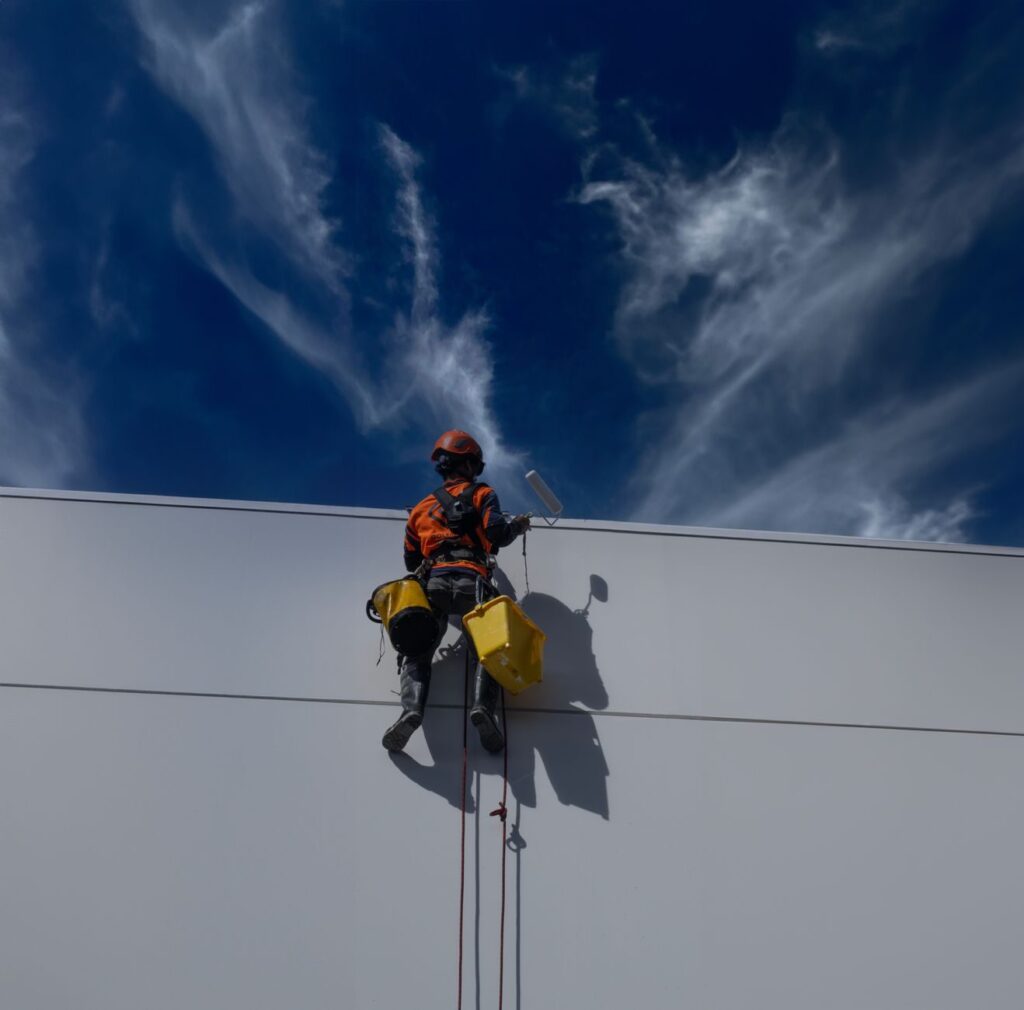
- Book a rope access inspection within days, not months.
- Keep invoices and reports so recovery from the right party is straightforward later.
Steps to take before the repair starts
Start with a visual inspection of the balcony from ground level and from inside the lot, if access is available. Look for spalling concrete, rust stains, cracks wider than 2 mm and any deflection you can feel underfoot. Take photos and note which balconies show the same pattern of damage, because a cluster often points to a building-wide issue rather than one-off neglect.
Next, pull out the plan of subdivision for the building and check the lot boundary for each affected balcony. The plan is held by the owners corporation manager or available through Land Use Victoria. Match what you see on site to the boundary description before you spend money on a report, because a five-minute check of the plan can settle the question of who pays without further cost.
If the damage is more than surface deep, commission a condition report from a structural engineer or a competent rope access contractor. The report should identify the cause of the defect, whether it is confined to one lot or common to the building, and what remediation is needed. A written report gives the committee something to table at a meeting and a basis for apportioning cost under section 48 of the Owners Corporations Act 2006.
Once the report is in hand, the committee decides the split:
- Confirm which parts of the repair fall on common property and which on the lot, based on the plan of subdivision and the engineer's findings.
- Get a fixed-price quote or a rate schedule for the work, including edge protection, access equipment and waste removal.
- Put the repair and the proposed cost split to the lot owner in writing, with a copy of the report and the quote attached.
- If the lot owner disputes the split, seek legal advice before work starts rather than after the invoice arrives.
- Book the access and the repair once the funding responsibility is agreed and the lot owner has confirmed access to the balcony.
If the repair is urgent enough that waiting for a committee resolution would put people or property at risk, proceed under the emergency powers in the Act and sort out the money afterwards. But for everything else, doing the steps in order keeps the job moving and avoids a dispute that costs more than the repair itself.
FAQ
Does the owners corporation always pay for waterproofing on a balcony?
Not always. If the waterproofing membrane is part of the common property, the owners corporation pays. If the plan of subdivision makes the membrane part of the lot, the lot owner pays. The wording on the plan is what decides.
Can the owners corporation recover the cost from a lot owner who refuses to pay?
Yes. Under the Owners Corporations Act 2006, the owners corporation can issue a fee notice for the lot's share. If it remains unpaid, the process for debt recovery is the same as for unpaid levies.
Who pays if a balcony repair is needed because the lot owner neglected it?
The owners corporation can do the work and recover the cost from the lot owner if the neglect damaged common property or created a safety risk. This needs a clear report linking the neglect to the damage.
What if the plan of subdivision is silent on the balcony boundary?
If the plan is silent, the default position under the act is that the balcony is part of the lot. The lot owner pays for its repair. The owners corporation pays only for any part that is clearly common property, such as a structural slab that extends beyond the lot.